
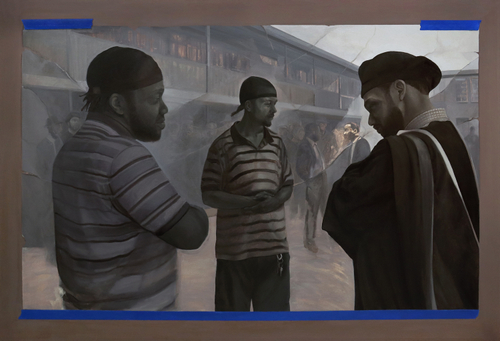
Kyle Hackett, For A.G. Gaston (Birmingham), 2025
History In the Making | Kyle Hackett
In honor of Black History Month—and in recognition of our broad, worldwide audiences who engage beyond Baltimore’s city limits—Goya Contemporary is pleased to introduce our month-long digital exhibition series, History: In the Making. We invite you to spend time with these works, engage with them digitally in greater depth, and join us in celebrating the extraordinary achievements of each visual practitioner featured in the series.
For A.G. Gaston (Birmingham)
2025
Oil on canvas
50 x 73 inches
For A.G. Gaston (Birmingham) marks a pivotal shift in the practice of artist Kyle Hackett. The painting foregrounds tensions between institutional archives and personal records, engaging the grandiosity of history painting through an informal, salon-style lens. Hackett approaches group portraiture as both image and dimensional artifact, incorporating self-referential photographic materials and the visible “wear and tear” of archival forms to interrogate how identity is constructed within historical genres. Central to this inquiry is the question of how the language of painting can operate both within and against the conventions it inherits.
The work emerged from Hackett’s 2023 solo exhibition, Circular Narratives, and a research trip to Birmingham, Alabama, where he examined the layered histories embedded in sites such as the Gaston Motel. During segregation, the motel offered first-class amenities, including air conditioning, to Black travelers navigating the constraints of Jim Crow. It served as a sanctuary for civil rights leaders such as Malcolm X and Dr. Martin Luther King Jr. before becoming the target of bombing and vandalism in 1963. The building later closed in 1986 and was repurposed as a senior living residence. Now a Smithsonian-affiliated landmark, the Gaston Motel stands as a vital archive of Black leadership and of Birmingham’s complex civic history.
In For A.G. Gaston (Birmingham) Hackett transposes a photograph—originally taken after returning home to deliver his high school commencement address—of his brother and a close friend onto a backdrop derived from the motel’s promotional brochure. In doing so, he symbolically “carries family into the archive,” collapsing temporal and spatial distance. Hackett’s brother not only accompanied him on the Birmingham site visit but also contributed to the curation of the exhibition, reinforcing the painting’s grounding in lived relationality.
The work operates simultaneously as a tribute to an intimate group dynamic and as a formal dialogue with the national histories that condition its possibility. Through this synthesis of psychological proximity and material citation, Hackett reframes painting’s capacity to illuminate contemporary power structures and value systems, positioning the medium as both witness to and participant in the ongoing construction of historical meaning.
Kyle Hackett’s paintings examine race, class, and social stratification through strategies of self-representation and the constructed image. Drawing from nineteenth- and twentieth-century portraiture, as well as historically precarious modes of depiction, he destabilizes notions of fixed identity and authoritative technique. Through staged and self-aware portraits, Hackett interrogates the mechanics of image-making itself. He references contraptions, braces, and rigid postures associated with early photography—devices that physically stabilized and, at times, objectified the sitter—to connect ideas of pictorial restraint and inflection with the psychic tension of double consciousness.
A related body of Vanitas still-life paintings emerges from discarded self-portrait reference photographs. Compressed, twisted, bound, doubled, and suspended, these rejected images are transformed into sculptural subjects. The deliberate, extended process of rendering each painting stands in contrast to the immediacy of the photographic source, becoming both a record of and meditation on the act of refusal. Within this exchange, Hackett foregrounds the power dynamics embedded in the picture plane, positioning the painted surface as a site where political and psychological forces converge.
Hackett further investigates how authenticity, self-referential materials, and painting method can articulate systems of identity and contemporary power within—and against—the conventions of historical genres such as portraiture. By constructing images that expose their own artifice, he proposes alternative frameworks for institutional and personal identity-making. Employing indirect glazing and layered surfaces, he situates meaning in the spaces between subjects, within accumulated strata of paint, and beneath the visible image. This measured pacing of production and viewing challenges the relationship between image, surface, and material, while also offering insight into the artist’s psychological register. By emphasizing the tension between interior and exterior states, Hackett’s work invites viewers to consider modes of understanding that move beyond fixed positions toward a more expansive conception of human presence.
KYLE HACKETT
Biography
Born in Still Pond, Maryland, Hackett received his MFA from the LeRoy E. Hoffberger School of Painting at the Maryland Institute College of Art and his BFA in Fine Arts from the University of Delaware.
He is the recipient of numerous honors, including the DC Commission on the Arts and Humanities Artist Fellowship, the Civil Society Institute Fellowship at the Vermont Studio Center Residency, the Ruth Katzman Scholarship at The League Residency in New York, and Best in Show at the 2014 Bethesda Painting Awards Exhibition. His work has been featured in New American Paintings, The Washington Post, HuffPost, and Aesthetica Magazine (UK), and the National Portrait Gallery's Portrait Award publication in the British Library collection.
Hackett received a Mayoral Salute from the City of Baltimore for his solo exhibition Rate of Contingency. Recent exhibitions include the Ruth Borchard 2025 Self-Portrait Prize (UK); the Herbert Smith Freehills 2024 Portrait Award Exhibition at the National Portrait Gallery, London; Revisit/Reimagine at the Banneker-Douglass-Tubman Museum (Annapolis, MD); and Circular Narratives at Vinegar Projects (Birmingham, AL).
His work is represented by Goya Contemporary Gallery (Baltimore, MD) and is included in collections such as Ethan Cohen Gallery (New York), the DC Commission on the Arts and Humanities Art Bank, the Capital One Lounge at Washington Dulles International Airport, and the Soho House Art Collection, among others. Hackett is Assistant Professor and Co-Director of the MFA Studio Art Program at American University in Washington, DC.
Click here to view digital exhibition