Sonya Clark Confederate, Surrender, 2022
Mixografia print on handmade paper
43.75 x 23.25 x 0.75 in. (111.13 x 59.06 x 1.91 cm)
Edition of 30
Clar-1114-C
Sonya Clark’s Confederate, Surrender centers on a seemingly quotidian object imbued with monumental historical weight: a white tea towel with red pin stripes, originally woven in Richmond, Virginia. The work examines the history of the Confederate Flag of Truce raised by General Robert E. Lee’s army at Appomattox (April 9, 1865).1 Fashioned from a simple kitchen dish towel, the Truce Flag signaled the collapse of soldiers fighting to preserve the institution of slavery.
By reconstructing this object in print, Clark disrupts the visual dominance of the Confederate battle flag—a symbol inextricably linked to the violent defense of Black enslavement and its persistent legacy of racism. Instead, she redirects attention to the modest textile that signaled the Confederacy’s surrender—the quiet wave of a domestic object that initiated the formal conclusion of a war waged against Black freedom.
In an interview between Sonya Clark and Paul Farber, archived on the Monument Lab website, Clark recalls her experience as a Smithsonian Institution Artist Research Fellow in 2011. During that time, she visited the National Museum of American History, where a long line of visitors had gathered to view the Star-Spangled Banner. In another exhibit, she encountered Abraham Lincoln’s iconic top hat, displayed within an exhibition on American presidents. In the same display case, however, she noticed a small, folded textile labeled “Confederate Flag of Truce”—a quiet but charged object placed alongside one of the nation's most revered presidential artifacts.
“It wasn’t hidden, just largely unamplified,” said Clark. “It is not that it was undiscovered, but that it hasn’t lived in public memory the way other flags have”— And so she sought to bring attention to that overlooked history.2 “I suspect most people know the Confederate flag but don’t know about the Confederate truce flag?” said Clark. “What would it mean if we had focused our attention on the surrender and all that it implied? Where might we be now?”3
[Note to reader: American historian, museum director, and public scholar Dr. Lonnie G. Bunch III curated the “Truce Flag” into the aforementioned exhibition before later serving as the founding director of the National Museum of African American History and Culture and, subsequently, as Secretary of the Smithsonian Institution.]
As an intimate domestic textile, a dish towel is typically handled, folded, and worn through repetitive labor. In this dimensional print—rendered to emphasize the truce flag’s specific weave structure—Sonya Clark elevates a once-utilitarian cloth into a charged historical artifact.
Clark characterizes her engagement with fraught national symbols as an “amplifying, educative intervention.”4 Rather than smoothing over tension, she preserves it through tactile processes that insist on material and historical presence. By reimagining the towel-turned-truce flag, Clark reframes surrender not as mutual reconciliation between equal parties, but as the necessary dismantling of a regime built upon racial violence.
Through this artistic gesture, Sonya Clark redirects national memory toward an object worthy of recognition, replacing Confederate iconography with a symbol of its collapse.
Clark states, “That's the power of art. That's one of the things I can do as an artist—I can use my voice to amplify this historical object and other historical objects that changed our path.”5 “Amplify” is precisely what Clark accomplishes.
Confederate, Surrender centers our attention on the exact moment a system committed to enslavement was forced to yield. By foregrounding the truce flag, Clark surfaces a history that has been muted or overlooked. In doing so, Confederate, Surrender honors not only the end of the Confederacy, but also the profoundly unfinished struggle for justice that followed emancipation—and that continues today.
-Writing by Amy Raehse unless otherwise noted.
Footnote
[1] Rubenstein, Harry, R., “The Gentleman’s Agreement that Ended the Civil War,” What It Means to Be American, April 3, 2015
[2] Sonya Clark and Paul Farber, Monument Lab Podcast, Episode12, March 2019. https://monumentlab.com/podcast/in-pursuit-of-the-confederate-truce-flag-with-artist-sonya-clark
[3] Sonya Clark, describing her Monument Lab Podcast interview via email, 2026
[4] Sonya Clark, describing her engagement with charged historical textiles as “an act of care,” in phone conversation, 2025
[5] Sonya Clark, describing in email, 2026
This work was produced at the Mixografia print atelier. For three generations, the Remba family has shaped the field of printmaking and is recognized for developing and refining their innovative three-dimensional printing technique over more than 50 years. For the past 25 years, Goya Contemporary has worked alongside our print colleagues at Mixografia. As fellow members of the IFPDA—including service on its Board of Directors—we share a commitment to the highest standards of care, ethics, and connoisseurship in printmaking, as well as a mutual dedication to creating space for artistic vision. We are proud to represent these extraordinary prints, the histories they illuminate, and the spirit of collaboration they embody between artist, atelier, and gallery.
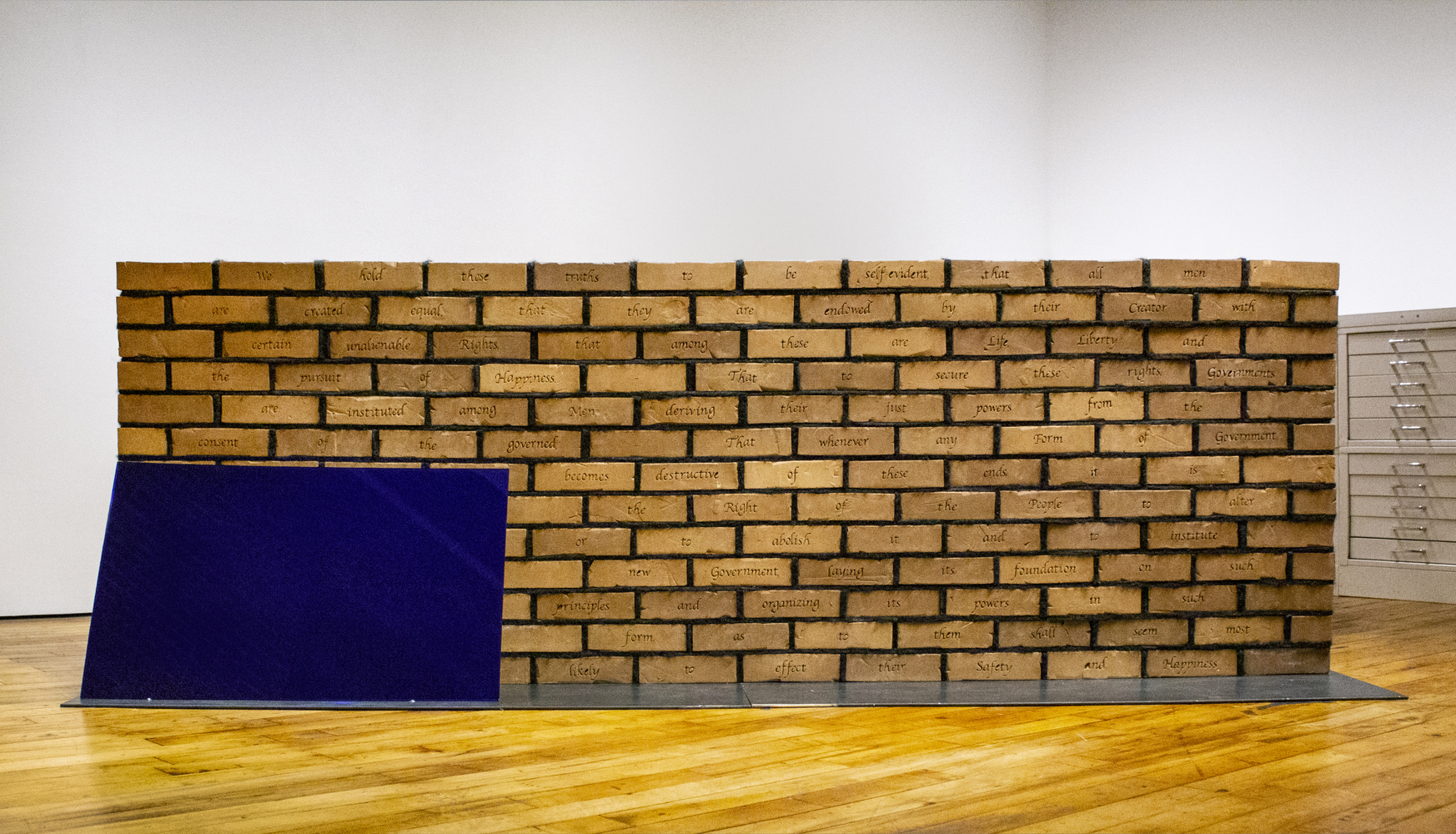
Sonya Clark Edifice and Mortar, 2018
Hand stamped bricks, human hair, glass, steel base
39 x 72 x 15 in. (99.1 x 182.9 x 38.1 cm)
Clar-1034-C
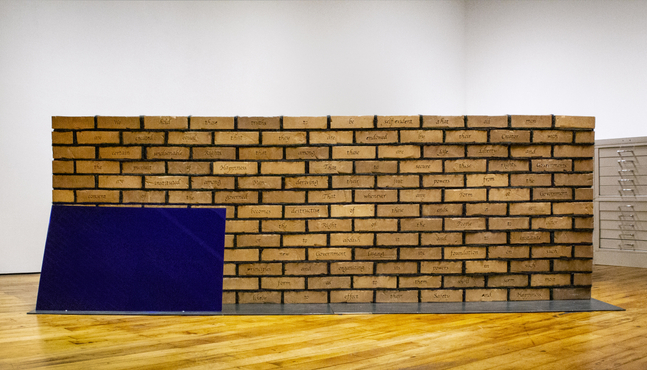
Sonya Clark describes Edifice & Mortar as “a wall, a flag, and a document”—three forms that hold boundless symbolism. In this work, Clark asks a foundational question: Who truly laid the foundations of the United States? By transforming familiar national symbols into a tactile, bodily structure, she reframes the story of American origins.
The piece is constructed from hand-cast bricks, each stamped with a traditional mason’s maker’s mark (verso) and a single word (recto). When the recto (front-facing) text is read together across the surface, the bricks form an excerpt from the United States Declaration of Independence. The recto text evokes the authority and permanence of the founding document, but its physical fragmentation across individual bricks underscores the labor required to build both text and nation. The words “life, liberty, and the pursuit of happiness” appear not as abstract ideals but as components of a literal structure—suggesting that these promises were materially constructed, unevenly distributed, and historically denied to many.
Between the bricks, Clark replaces conventional mortar with tightly packed African American hair collected from salons in Richmond, Virginia. Hair—a material deeply tied to identity, ancestry, and embodiment—introduces an intimate and visceral presence into the architecture of the piece. It references generations of Black Americans whose ancestors were enslaved at the nation’s founding and whose bodies fueled its economic and political growth. By using hair as binding material, Clark asserts that Black labor and Black lives have quite literally held the nation together. At the same time, the hair’s compressed form suggests the weight and pressure exerted by systemic racism—Black people “held under the weight of the system,” yet simultaneously sustaining it.
Each brick is also stamped with the word Schiavo, the Italian root of the common greeting “Ciao.” Translated into English, schiavo roughly translates into “slave.” This linguistic trace links everyday greetings to histories of bondage, reminding viewers how the legacy of enslavement permeates language and culture in ways often undetected. The maker’s mark—traditionally a sign of craftsmanship and pride—becomes instead a mark of possession, echoing how enslaved people were branded and treated as property.
The installation’s blue reflective panel is angled so that viewers see themselves within the work. This gesture implicates the present: the wall is not merely historical but contemporary. By catching the viewer’s reflection, Clark collapses the distance between past and present, asking us to consider our relationship to the structures that continue to shape the nation. We are not outside observers; we are part of the edifice.
Edifice & Mortar functions simultaneously as monument and critique, document and disruption. It honors the unacknowledged labor that built the country while confronting the contradictions embedded in its founding ideals. Through brick, human hair, language, and reflection, Clark transforms the language of nation-building into a meditation on memory, power, and belonging.
-Writing by Amy Raehse is the result of multiple conversations via phone and email between Sonya Clark and Amy Raehse over the course of three years (2019-2022.)
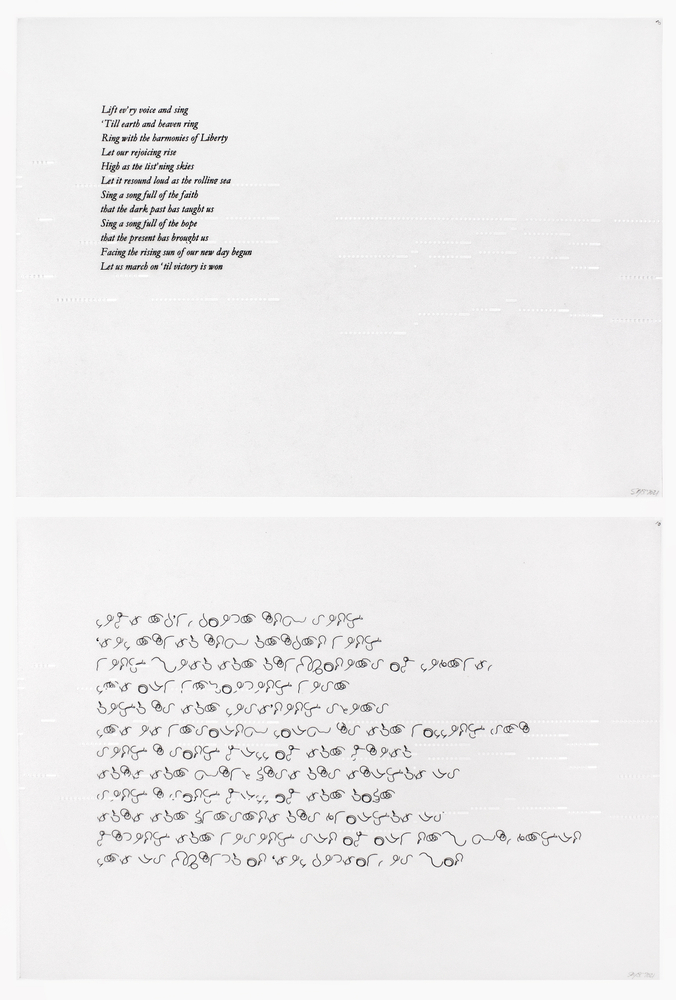
Sonya Clark Lift Ev'ry Voice and Sing, 2021
Archival pigment print on perforated piano paper
Diptych, 11 1/4 x 15 in. (28.57 x 38.1 cm) each
Variable edition of 20
Clar-1038-C
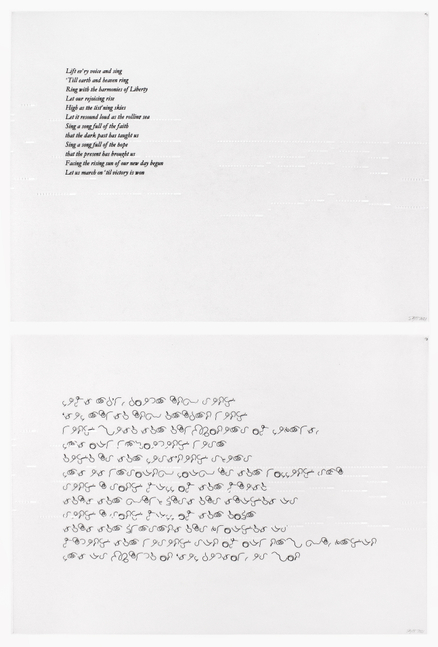
In this 2021 diptych, Sonya Clark references one of the most enduring hymns in African American history, “Lift Every Voice and Sing.” Written as a poem in 1900 by James Weldon Johnson and set to music by his brother J. Rosamond Johnson for a celebration of Abraham Lincoln’s birthday, the song has come to be widely known as the “Black National Anthem” in the United States. Its lyrics, resonant with faith, endurance, and collective striving, have long served as both remembrance and rallying cry. The song's popular culture reach extends in all directions, even recently performed at the 2026 Superbowl of American Football.
Clark’s work consists of two pieces printed on repurposed, perforated piano paper—material historically used in player pianos, where music is encoded through punched holes that mechanically trigger sound. This substrate is not incidental. Piano paper is a carrier of music, a technology that translates written notation into vibration. By printing the first verse of the hymn onto this surface, Clark overlays lyric and mechanism, voice and instrument. The sheet becomes both score and archive, suggesting that Black song has always been a form of record-keeping—a way of preserving memory, grief, hope, and resistance when other archives excluded or distorted Black life.
In the first panel, the lyrics appear in a clear, legible format, summoning the familiarity and communal power of the hymn:
“Lift every voice and sing
Till earth and heaven ring
Ring with the harmonies of Liberty
Let our rejoicing rise
High as the listening skies
Let it resound loud as the rolling sea
Sing a song full of the faith that the dark past has taught us
Sing a song full of the hope that the present has brought us
Facing the rising sun of our new day begun
Let us march on till victory is won.”
The perforations interrupt the text, visually puncturing the lines. These holes—once guides for the automated sound—now read as absences, pauses, or wounds within the page. They remind viewers that Black expression in America has often been mediated, constrained, or mechanized by systems not of its own making.
The second panel repeats the same verse using Clark’s own invented typeface, formed by shaping her personal hair into letterforms. Hair, throughout Clark’s practice, operates as a deeply charged material—intimate, bodily, and historically politicized. Language becomes human and bodily; the hymn is not simply printed but grown and shaped by physical presence.
This doubling of the verse creates a visual echo, much like the call-and-response structure central to Black musical traditions. Together, they suggest that cultural inheritance is not inert repetition but living reinterpretation. Each generation must “lift” the song anew. The hymn’s promise of liberty remains hopeful; its call to “march on till victory is won” still unfinished.
As in much of Clark’s work, historical redress is indissoluble from contemporary critique. Lift Ev’ry Voice and Sing does not merely commemorate a song—it materializes it as something that must continually be sounded into being.
![Sonya Clark
Confederate, Surrender, 2022
Mixografia print on handmade paper
43.75 x 23.25 x 0.75 in. (111.13 x 59.06 x 1.91 cm)
Edition of 30
Clar-1114-C
 
Sonya Clark’s Confederate, Surrender centers on a seemingly quotidian object imbued with monumental historical weight: a white tea towel with red pin stripes, originally woven in Richmond, Virginia. The work examines the history of the Confederate Flag of Truce raised by General Robert E. Lee’s army at Appomattox (April 9, 1865).1 Fashioned from a simple kitchen dish towel, the Truce Flag signaled the collapse of soldiers fighting to preserve the institution of slavery.
By reconstructing this object in print, Clark disrupts the visual dominance of the Confederate battle flag—a symbol inextricably linked to the violent defense of Black enslavement and its persistent legacy of racism. Instead, she redirects attention to the modest textile that signaled the Confederacy’s surrender—the quiet wave of a domestic object that initiated the formal conclusion of a war waged against Black freedom.
In an interview between Sonya Clark and Paul Farber, archived on the Monument Lab website, Clark recalls her experience as a Smithsonian Institution Artist Research Fellow in 2011. During that time, she visited the National Museum of American History, where a long line of visitors had gathered to view the Star-Spangled Banner. In another exhibit, she encountered Abraham Lincoln’s iconic top hat, displayed within an exhibition on American presidents. In the same display case, however, she noticed a small, folded textile labeled “Confederate Flag of Truce”—a quiet but charged object placed alongside one of the nation's most revered presidential artifacts.
“It wasn’t hidden, just largely unamplified,” said Clark. “It is not that it was undiscovered, but that it hasn’t lived in public memory the way other flags have”— And so she sought to bring attention to that overlooked history.2 “I suspect most people know the Confederate flag but don’t know about the Confederate truce flag?” said Clark.   “What would it mean if we had focused our attention on the surrender and all that it implied? Where might we be now?”3
[Note to reader: American historian, museum director, and public scholar Dr. Lonnie G. Bunch III curated the “Truce Flag” into the aforementioned exhibition before later serving as the founding director of the National Museum of African American History and Culture and, subsequently, as Secretary of the Smithsonian Institution.]
As an intimate domestic textile, a dish towel is typically handled, folded, and worn through repetitive labor. In this dimensional print—rendered to emphasize the truce flag’s specific weave structure—Sonya Clark elevates a once-utilitarian cloth into a charged historical artifact.
Clark characterizes her engagement with fraught national symbols as an “amplifying, educative intervention.”4 Rather than smoothing over tension, she preserves it through tactile processes that insist on material and historical presence. By reimagining the towel-turned-truce flag, Clark reframes surrender not as mutual reconciliation between equal parties, but as the necessary dismantling of a regime built upon racial violence.
Through this artistic gesture, Sonya Clark redirects national memory toward an object worthy of recognition, replacing Confederate iconography with a symbol of its collapse.
Clark states, “That's the power of art. That's one of the things I can do as an artist—I can use my voice to amplify this historical object and other historical objects that changed our path.”5 “Amplify” is precisely what Clark accomplishes.
Confederate, Surrender centers our attention on the exact moment a system committed to enslavement was forced to yield. By foregrounding the truce flag, Clark surfaces a history that has been muted or overlooked. In doing so, Confederate, Surrender honors not only the end of the Confederacy, but also the profoundly unfinished struggle for justice that followed emancipation—and that continues today.
-Writing by Amy Raehse unless otherwise noted.
 
Footnote
[1] Rubenstein, Harry, R., “The Gentleman’s Agreement that Ended the Civil War,” What It Means to Be American, April 3, 2015
[2] Sonya Clark and Paul Farber, Monument Lab Podcast, Episode12, March 2019. https://monumentlab.com/podcast/in-pursuit-of-the-confederate-truce-flag-with-artist-sonya-clark
[3] Sonya Clark, describing her Monument Lab Podcast interview via email, 2026
[4] Sonya Clark, describing her engagement with charged historical textiles as “an act of care,” in phone conversation, 2025
[5] Sonya Clark, describing in email, 2026
 
This work was produced at the Mixografia print atelier. For three generations, the Remba family has shaped the field of printmaking and is recognized for developing and refining their innovative three-dimensional printing technique over more than 50 years. For the past 25 years, Goya Contemporary has worked alongside our print colleagues at Mixografia. As fellow members of the IFPDA—including service on its Board of Directors—we share a commitment to the highest standards of care, ethics, and connoisseurship in printmaking, as well as a mutual dedication to creating space for artistic vision. We are proud to represent these extraordinary prints, the histories they illuminate, and the spirit of collaboration they embody between artist, atelier, and gallery.](https://static-assets.artlogic.net/w_1800,h_1000,c_limit/exhibit-e/60d360873baacb4f945010a9/1d854d40d49c4bf0b4e19b2b3f440acb.jpeg)
![Sonya Clark
Confederate, Surrender, 2022
Mixografia print on handmade paper
43.75 x 23.25 x 0.75 in. (111.13 x 59.06 x 1.91 cm)
Edition of 30
Clar-1114-C
 
Sonya Clark’s Confederate, Surrender centers on a seemingly quotidian object imbued with monumental historical weight: a white tea towel with red pin stripes, originally woven in Richmond, Virginia. The work examines the history of the Confederate Flag of Truce raised by General Robert E. Lee’s army at Appomattox (April 9, 1865).1 Fashioned from a simple kitchen dish towel, the Truce Flag signaled the collapse of soldiers fighting to preserve the institution of slavery.
By reconstructing this object in print, Clark disrupts the visual dominance of the Confederate battle flag—a symbol inextricably linked to the violent defense of Black enslavement and its persistent legacy of racism. Instead, she redirects attention to the modest textile that signaled the Confederacy’s surrender—the quiet wave of a domestic object that initiated the formal conclusion of a war waged against Black freedom.
In an interview between Sonya Clark and Paul Farber, archived on the Monument Lab website, Clark recalls her experience as a Smithsonian Institution Artist Research Fellow in 2011. During that time, she visited the National Museum of American History, where a long line of visitors had gathered to view the Star-Spangled Banner. In another exhibit, she encountered Abraham Lincoln’s iconic top hat, displayed within an exhibition on American presidents. In the same display case, however, she noticed a small, folded textile labeled “Confederate Flag of Truce”—a quiet but charged object placed alongside one of the nation's most revered presidential artifacts.
“It wasn’t hidden, just largely unamplified,” said Clark. “It is not that it was undiscovered, but that it hasn’t lived in public memory the way other flags have”— And so she sought to bring attention to that overlooked history.2 “I suspect most people know the Confederate flag but don’t know about the Confederate truce flag?” said Clark.   “What would it mean if we had focused our attention on the surrender and all that it implied? Where might we be now?”3
[Note to reader: American historian, museum director, and public scholar Dr. Lonnie G. Bunch III curated the “Truce Flag” into the aforementioned exhibition before later serving as the founding director of the National Museum of African American History and Culture and, subsequently, as Secretary of the Smithsonian Institution.]
As an intimate domestic textile, a dish towel is typically handled, folded, and worn through repetitive labor. In this dimensional print—rendered to emphasize the truce flag’s specific weave structure—Sonya Clark elevates a once-utilitarian cloth into a charged historical artifact.
Clark characterizes her engagement with fraught national symbols as an “amplifying, educative intervention.”4 Rather than smoothing over tension, she preserves it through tactile processes that insist on material and historical presence. By reimagining the towel-turned-truce flag, Clark reframes surrender not as mutual reconciliation between equal parties, but as the necessary dismantling of a regime built upon racial violence.
Through this artistic gesture, Sonya Clark redirects national memory toward an object worthy of recognition, replacing Confederate iconography with a symbol of its collapse.
Clark states, “That's the power of art. That's one of the things I can do as an artist—I can use my voice to amplify this historical object and other historical objects that changed our path.”5 “Amplify” is precisely what Clark accomplishes.
Confederate, Surrender centers our attention on the exact moment a system committed to enslavement was forced to yield. By foregrounding the truce flag, Clark surfaces a history that has been muted or overlooked. In doing so, Confederate, Surrender honors not only the end of the Confederacy, but also the profoundly unfinished struggle for justice that followed emancipation—and that continues today.
-Writing by Amy Raehse unless otherwise noted.
 
Footnote
[1] Rubenstein, Harry, R., “The Gentleman’s Agreement that Ended the Civil War,” What It Means to Be American, April 3, 2015
[2] Sonya Clark and Paul Farber, Monument Lab Podcast, Episode12, March 2019. https://monumentlab.com/podcast/in-pursuit-of-the-confederate-truce-flag-with-artist-sonya-clark
[3] Sonya Clark, describing her Monument Lab Podcast interview via email, 2026
[4] Sonya Clark, describing her engagement with charged historical textiles as “an act of care,” in phone conversation, 2025
[5] Sonya Clark, describing in email, 2026
 
This work was produced at the Mixografia print atelier. For three generations, the Remba family has shaped the field of printmaking and is recognized for developing and refining their innovative three-dimensional printing technique over more than 50 years. For the past 25 years, Goya Contemporary has worked alongside our print colleagues at Mixografia. As fellow members of the IFPDA—including service on its Board of Directors—we share a commitment to the highest standards of care, ethics, and connoisseurship in printmaking, as well as a mutual dedication to creating space for artistic vision. We are proud to represent these extraordinary prints, the histories they illuminate, and the spirit of collaboration they embody between artist, atelier, and gallery.](https://static-assets.artlogic.net/w_647,h_647,c_limit/exhibit-e/60d360873baacb4f945010a9/1d854d40d49c4bf0b4e19b2b3f440acb.jpeg)