After Judgement, 2018
Oil on panel
48 x 28 in. (121.9 x 71.1 cm)
Hack-1013-C
"After Judgement is among the artist’s earliest self-portraits in regalia. The painting was inspired by his experiences as a faculty member in academia, as well as his roles as commencement speaker at his high school and at the convocation of his alma mater college. Through these experiences, he became interested in institutional hierarchy and its implications for status, posture, and positioning. At the same time, his work is attentive to the human dimensions that underlie these structures, as well as the distinctions of costume and symbolic presentation. He considers the complex psychological dynamics of regalia within institutional contexts and how these relate to power structures and the politics of visual representation."*
*Excerpted from the publication “Unfinished Republic: America at 250,” ISBN: 979-8-3507-6518-2, page 22.
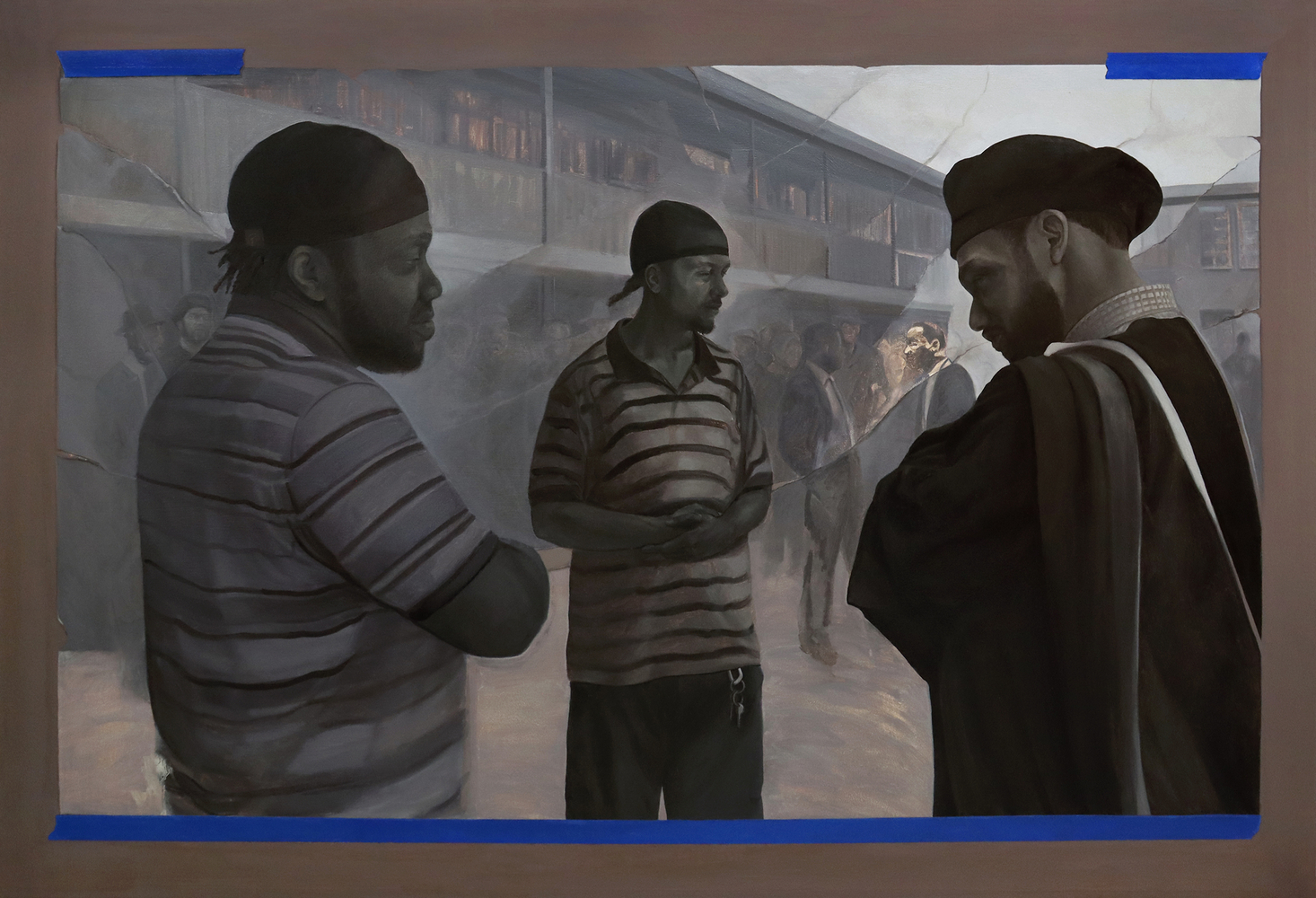
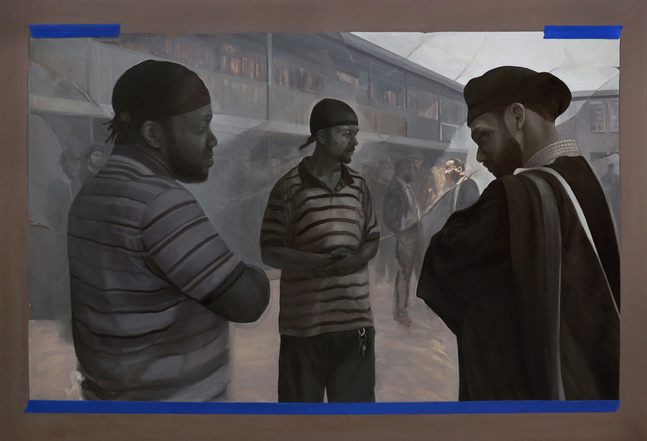
For A.G. Gaston (Birmingham), 2025
Oil on canvas
50 x 73 in. (127 x 185.4 cm)
Hack-1011-C
"For A.G. Gaston (Birmingham) marks a pivotal shift in the practice of Kyle Hackett. The painting foregrounds tensions between institutional archives and personal memory, engaging the traditions of history painting through a more intimate, salon-style lens. Hackett approaches group portraiture as both image and artifact, incorporating photographic source material and the visible “wear and tear” of archival forms to examine how identity is constructed within historical representation. Central to the work is the question of how painting can operate both within and against the conventions it inherits.
The painting emerged from Hackett’s 2023 solo exhibition Circular Narratives and a research trip to Birmingham, where he studied the layered histories surrounding sites such as the A. G. Gaston Motel. During segregation, the motel provided first-class accommodations, including air conditioning, for Black travelers navigating the restrictions of Jim Crow. It also served as a gathering place for civil rights leaders including Malcolm X and Martin Luther King Jr. before becoming the target of bombing and vandalism in 1963. The building later closed in 1986 and was subsequently repurposed as a senior living residence. Today, as a Smithsonian-affiliated landmark, the Gaston Motel stands as an important archive of Black leadership and Birmingham’s complex civic history.
In For A.G. Gaston (Birmingham), Hackett transposes a photograph — originally taken after returning home to deliver his high school commencement address — depicting his brother and a close friend onto a backdrop derived from the motel’s promotional brochure. In doing so, he symbolically carries family into the archive, collapsing temporal and spatial distance. Hackett’s brother not only accompanied him during the Birmingham research trip, but also contributed to the exhibition’s curation, reinforcing the work’s grounding in lived experience and relational memory.
The painting operates simultaneously as a tribute to personal relationships and as a meditation on the national histories that shape them. Through this synthesis of intimacy, archival reference, and material citation, Hackett reframes painting as both witness to and participant in the ongoing construction of historical meaning."*
*Excerpted from the publication “Unfinished Republic: America at 250,” ISBN: 979-8-3507-6518-2, page 38.
After Private John Hackett, 2022
Oil on aluminum
30 x 24 in. (76.2 x 61 cm)
Hack-1012-C
"Kyle Hackett, in his own words, explains that this work is informed by research into his second great-grandfather, John Hackett, who served in the Union Army during the American Civil War, and became a foundational figure in the family’s Maryland roots. Born into slavery around 1845, John Hackett’s life followed a remarkable trajectory — from enslavement to service on the front lines of the Civil War, and ultimately to civic leadership in the postwar period.
The artist depicts himself in uniform as a way of connecting to and reclaiming this lineage, channeling the legacy of John Hackett’s service in the 29th United States Colored Troops. Through military enlistment, J. Hackett gained his freedom and witnessed pivotal moments in American history, including surviving the Battle of the Crater in Petersburg, Virginia, and standing in Galveston, Texas, on June 19, 1865, as Union forces enforced emancipation on what would become known as Juneteenth.
By engaging J. Hackett’s military service and his later life as a homeowner in the artist’s hometown, the work reflects on ancestry as both personal inheritance and historical record. It positions Hackett as a patriarchal figure within the family line while also considering the artist’s present-day relationship to that legacy. Ultimately, the work functions as a form of research and reflection, situating personal history within the broader narrative of the American story."*
*Excerpted from the publication “Unfinished Republic: America at 250,” ISBN: 979-8-3507-6518-2, page 18.